
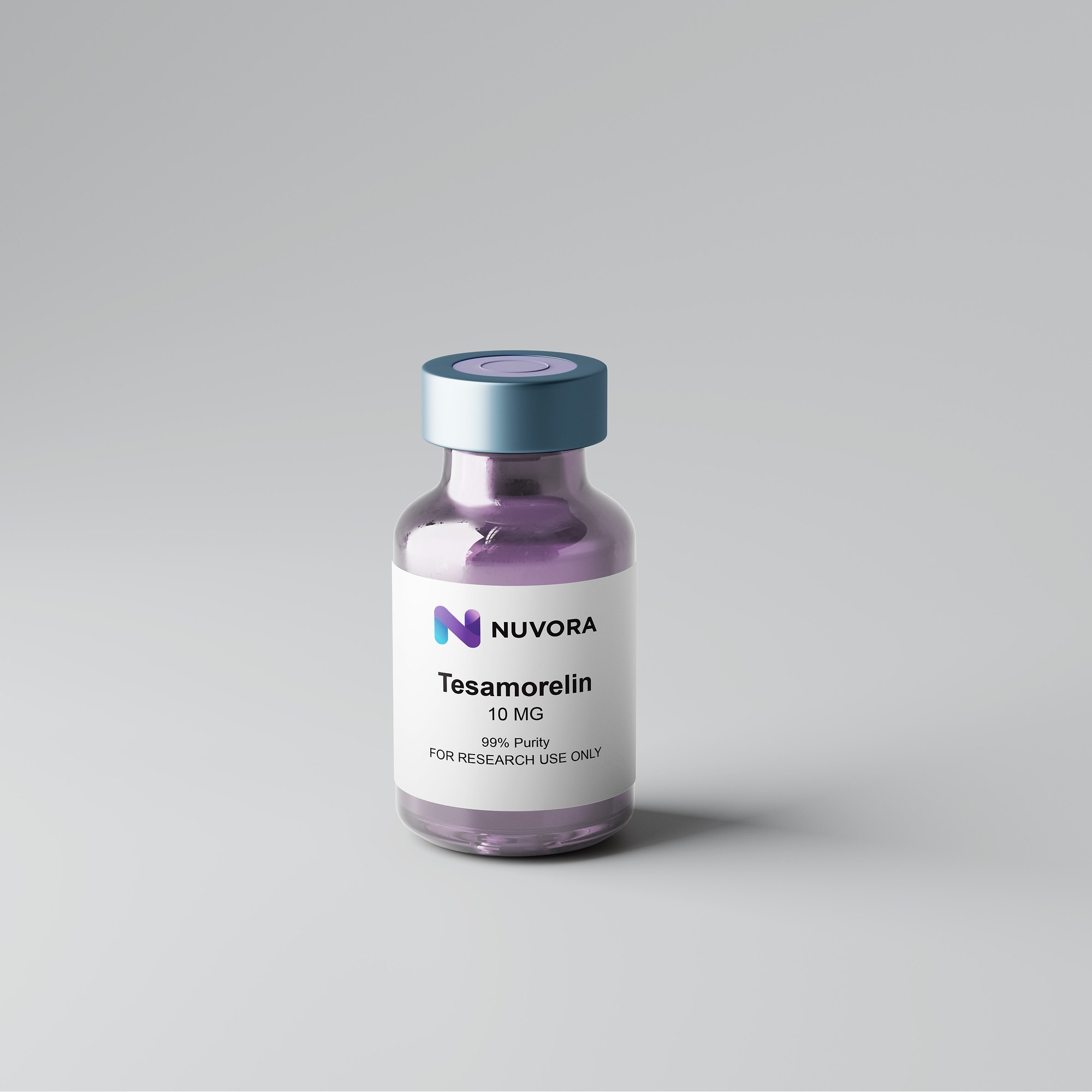
Description
Research Applications:
Growth Hormone Secretion and Pituitary Axis Activation
Tesamorelin functions as a stabilized GHRH analog that binds to GHRH receptors in the anterior pituitary, stimulating the release of endogenous GH in a pulsatile fashion. Unlike direct GH administration, Tesamorelin preserves the hypothalamic-pituitary feedback loop, allowing researchers to study physiological regulation of GH and IGF-1 in a controlled context [1].
In in-vivo and in-vitro models, Tesamorelin has demonstrated dose-dependent increases in GH and downstream insulin-like growth factor 1 (IGF-1) production, enabling detailed study of the GH/IGF-1 axis.
Lipid Metabolism and Adipose Tissue Studies
Tesamorelin has been widely investigated for its effects on visceral adipose tissue (VAT) and lipid metabolism. GH is known to exert lipolytic activity via hormone-sensitive lipase activation, and Tesamorelin-induced GH secretion has been observed to reduce VAT in animal and clinical research models without significantly affecting subcutaneous fat [2].
This selectivity makes it a useful tool in metabolic and obesity-related research, particularly in examining the differential effects of GH on various fat depots and its role in lipid mobilization.
Endocrine Regulation and Feedback Dynamics
Due to its indirect mechanism of action through endogenous hormone stimulation, Tesamorelin is used to model negative feedback inhibition and receptor sensitivity in endocrine studies. Researchers use it to assess how chronic or pulsatile GHRH receptor stimulation affects pituitary responsiveness, somatostatin tone, and hypothalamic regulation under different physiological conditions [3].
This makes Tesamorelin particularly valuable for long-term endocrine studies focused on hormone adaptation and regulation.
Protein Synthesis and Anabolism
GH stimulates protein synthesis and nitrogen retention, and Tesamorelin has been studied in models involving muscle growth, cachexia, and catabolic states. It increases circulating IGF-1 levels, which is a key mediator of anabolic activity in skeletal muscle and bone tissue [4].
Researchers often measure Tesamorelin-induced changes in amino acid turnover, lean body mass, and myogenic gene expression to evaluate GH/IGF-1 effects at the cellular level.
Referenced Citations:
- Teichman SL, et al. “Pharmacokinetics and GH response to Tesamorelin.” PubMed
Source: Journal of Clinical Endocrinology & Metabolism – GH pulsatility and IGF-1 response. - Stanley TL, et al. “Tesamorelin and visceral fat reduction in metabolic models.” PubMed
Source: Journal of Clinical Endocrinology & Metabolism – GH-dependent VAT modulation. - Walker RF, et al. “Tesamorelin: Endocrine feedback and receptor adaptation.” PubMed
Source: Endocrine Reviews – GHRH analogs and hypothalamic-pituitary regulation. - Yuen KCJ, et al. “GH-induced protein metabolism with Tesamorelin.” PubMed
Source: American Journal of Physiology – Anabolic effects through IGF-1 elevation.

Reviews
There are no reviews yet.